
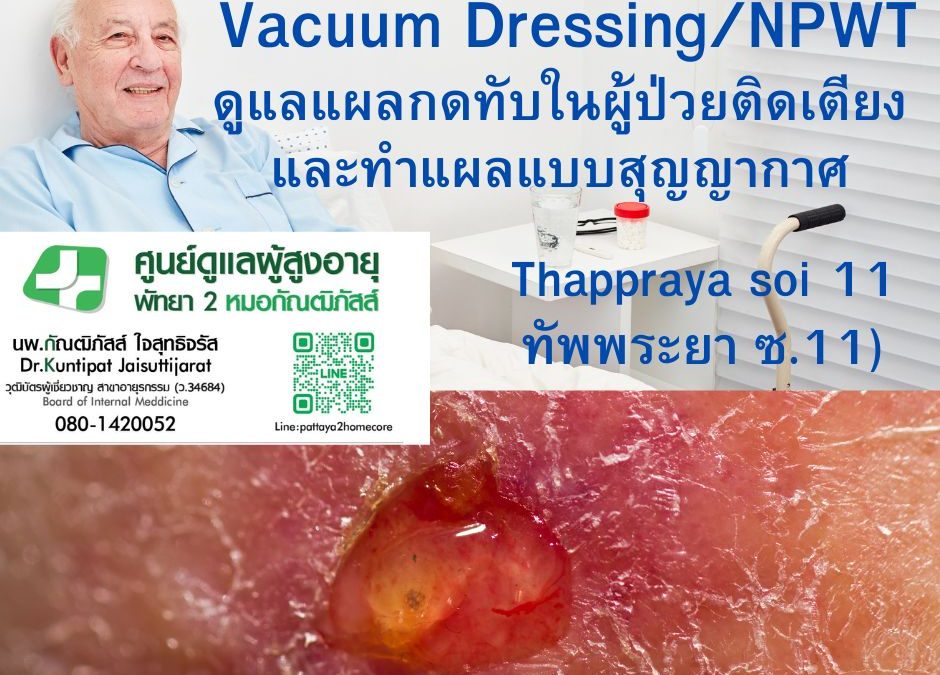
🩹 Pressure Ulcer Care in Bedridden Patients and Vacuum Dressing (NPWT)
Questions and Answers (Q&A) regarding pressure ulcer care guidelines for bedridden patients, including negative pressure wound therapy (NPWT) technology, according to the standards of Pattaya 2 Elderly Care Center, Dr. Kuntipat
🩺 Part 1: Prevention and Assessment of Pressure Ulcer
Q1: How do pressure ulcers (bed sores) occur? And how can we prevent them?
A: Pressure ulcers occur when the skin and tissues are compressed for extended periods, resulting in insufficient blood supply to the area and tissue death. They often occur over bony prominences such as the tailbone, heels, hips, and back.
Prevention guidelines emphasized at the center:
Turning: Turn the patient every 2 hours regularly to reduce pressure.
Using pressure-reducing devices: Use an air mattress or doughnut cushion to distribute weight.
Skin Care: Keep the skin dry and clean, especially in cases of urinary/fecal incontinence.
Adequate Nutrition: Ensure the patient receives sufficient protein and nutrients for tissue repair and regeneration.
Q2: What are the stages of pressure ulcers, and how are they assessed at the center?
A: Pressure ulcers are divided into four main stages (according to the commonly used assessment system):
Stage 1: The skin is not open, but there is redness that does not fade when pressure is applied.
Stage 2: The outer layer of skin (epidermis) or part of the dermis is damaged, appearing as blisters or shallow abrasions.
Stage 3: The subcutaneous tissue is damaged down to the subcutaneous fat layer. Fat may be visible, but it does not reach the bone, muscle, or tendons.
Stage 4: Severe tissue damage extends to the muscle, bone, or other supporting structures.
Assessment at the Center: Nurses regularly use risk assessment tools such as the Braden Scale and evaluate wounds based on stage, depth, size, and tissue characteristics (necrosis, regenerating tissue, pus/exudate volume) to determine appropriate treatment plans.
🧼 Part 2: Vacuum Dressing (NPWT)
Q3: What is vacuum dressing (NPWT) and what stages of pressure ulcers is it used for?
A: Vacuum dressing, or Negative Pressure Wound Therapy (NPWT), is a wound care technique that uses a device to create negative pressure or vacuum on the wound area.
Method: A physician or nurse places a special sponge or mesh on the wound, covers it with an occlusive dressing, and then connects it to a vacuum device.
Usage for pressure ulcers: It is commonly used for stage 3 and 4 pressure ulcers that are large, deep, have significant exudate, or have necrotic tissue that has been removed. To promote faster wound healing.
Q4: What are the main mechanisms of action and benefits of vacuum wound care?
A: NPWT helps treat pressure ulcers through several mechanisms:
Removal of exudate and pus: The suction continuously removes excess fluid and exudate from the wound, keeping it clean and reducing the risk of infection.
Reduction of swelling: Reduces swelling around the wound, improving blood circulation.
Stimulation of new tissue formation: Gentle suction pulls the wound edges together and stimulates microcirculation, leading to faster formation of granulation tissue.
Q5: What special precautions are needed when caring for patients with vacuum wound care at the center?
A: NPWT wound care requires more delicate attention than regular wound care:
Observation of leakage: Ensure the wound dressing is tightly sealed and there are no air leaks to ensure the negative pressure works effectively.
Management of exudate: Nurses regularly record the quantity and characteristics of exudate in the canister and replace it as needed.
Pain monitoring: Inquire about and assess the patient’s pain. Because the suction may cause tightness or pain.
Wound dressing changes: NPWT dressings are typically changed every 48-72 hours (depending on physician’s orders and wound condition) using strict aseptic technique.
🌟 Part 3: Summary and Recommendations from Dr. Kuntipat
Caring for pressure ulcers in bedridden patients requires understanding, consistency, and the use of appropriate technology. Prevention is the best cure, but if an ulcer has already occurred, NPWT (Non-Performing Wound Wound Treatment) is a highly effective option to accelerate the healing of severe ulcers.
“The medical and nursing team at Pattaya 2 Elderly Care Center, Dr. Kuntipat , is well-equipped and experienced in assessing and caring for pressure ulcers at all stages, including the proper use of NPWT technology, to ensure our patients receive the highest standard of wound care and regain a better quality of life.”
+++++++++++++++++++++++++++++++++++++++++
#Pattaya 2 Nursing Home Care #Denmark #norway #Sweden #germany
#Denmark
🩹 Tryksårspleje hos sengeliggende patienter og vakuumforbinding (NPWT)
Spørgsmål og svar (Q&A) vedrørende retningslinjer for tryksårspleje hos sengeliggende patienter, herunder teknologi til negativ tryksårsbehandling (NPWT), i henhold til standarderne fra Pattaya 2 Elderly Care Center, Dr. Kuntipat
🩺 Del 1: Forebyggelse og vurdering af tryksår
Q1: Hvordan opstår tryksår? Og hvordan kan vi forebygge dem?
A: Tryksår opstår, når hud og væv komprimeres i længere perioder, hvilket resulterer i utilstrækkelig blodforsyning til området og vævsdød. De opstår ofte over knoglefremspring såsom haleben, hæle, hofter og ryg.
Forebyggelsesretningslinjer med vægt i midten:
Vending: Vend patienten regelmæssigt hver 2. time for at reducere trykket.
Brug af trykreducerende apparater: Brug en luftmadras eller donutpude til at fordele vægten.
Hudpleje: Hold huden tør og ren, især i tilfælde af urin-/fækal inkontinens.
Tilstrækkelig ernæring: Sørg for, at patienten får tilstrækkeligt protein og næringsstoffer til vævsreparation og regenerering.
Spørgsmål 2: Hvad er stadierne af tryksår, og hvordan vurderes de på centret?
Svar: Tryksår er opdelt i fire hovedstadier (i henhold til det almindeligt anvendte vurderingssystem):
Stadie 1: Huden er ikke åben, men der er rødme, der ikke falmer, når der påføres tryk.
Stadie 2: Det ydre hudlag (epidermis) eller en del af dermis er beskadiget og fremstår som blærer eller overfladiske hudafskrabninger.
Stadie 3: Det subkutane væv er beskadiget ned til det subkutane fedtlag. Fedt kan være synligt, men det når ikke knogler, muskler eller sener.
Stadie 4: Alvorlig vævsskade strækker sig til muskler, knogler eller andre støttende strukturer.
Vurdering på centret: Sygeplejersker bruger regelmæssigt risikovurderingsværktøjer såsom Braden-skalaen og evaluerer sår baseret på stadie, dybde, størrelse og vævskarakteristika (nekrose, regenererende væv, pus/ekssudatvolumen) for at bestemme passende behandlingsplaner.
🧼 Del 2: Vakuumforbinding (NPWT)
Spørgsmål 3: Hvad er vakuumforbinding (NPWT), og hvilke stadier af tryksår bruges det til?
Svar: Vakuumforbinding, eller negativ tryksårbehandling (NPWT), er en sårplejeteknik, der bruger en anordning til at skabe negativt tryk eller vakuum på sårområdet.
Metode: En læge eller sygeplejerske placerer en speciel svamp eller et net på såret, dækker det med en okklusiv forbinding og forbinder det derefter til en vakuumanordning.
Anvendelse til tryksår: Det bruges almindeligvis til tryksår i stadie 3 og 4, der er store, dybe, har betydelig ekssudat eller har nekrotisk væv, der er blevet fjernet. For at fremme hurtigere sårheling.
Spørgsmål 4: Hvad er de vigtigste virkningsmekanismer og fordele ved vakuumsårpleje?
Svar: NPWT hjælper med at behandle tryksår gennem flere mekanismer:
Fjernelse af ekssudat og pus: Sugning fjerner kontinuerligt overskydende væske og ekssudat fra såret, holder det rent og reducerer risikoen for infektion.
Reduktion af hævelse: Reducerer hævelse omkring såret, hvilket forbedrer blodcirkulationen.
Stimulering af ny vævsdannelse: Blid sugning trækker sårkanterne sammen og stimulerer mikrocirkulationen, hvilket fører til hurtigere dannelse af granulationsvæv.
Q5: Hvilke særlige forholdsregler er nødvendige ved pleje af patienter med vakuumsårpleje på centret?
A: NPWT-sårpleje kræver mere omhyggelig opmærksomhed end almindelig sårpleje:
Observation af lækage: Sørg for, at sårforbindingen er tæt forseglet, og at der ikke er luftlækager for at sikre, at det negative tryk fungerer effektivt.
Håndtering af ekssudat: Sygeplejersker registrerer regelmæssigt mængden og egenskaberne af ekssudat i beholderen og udskifter den efter behov.
Smerteovervågning: Spørg om og vurder patientens smerter. Da sugningen kan forårsage trykken eller smerter.
Skift af sårforbindinger: NPWT-forbindinger skiftes typisk hver 48.-72. time (afhængigt af lægens ordination og sårets tilstand) ved hjælp af streng aseptisk teknik.
🌟 Del 3: Resumé og anbefalinger fra Dr. Kuntipat
Behandling af tryksår hos sengeliggende patienter kræver forståelse, konsistens og brug af passende teknologi. Forebyggelse er den bedste kur, men hvis der allerede er opstået et sår, er NPWT (Non-Performing Wound Wound Treatment) en yderst effektiv mulighed for at fremskynde helingen af alvorlige sår.
“Det medicinske og sygeplejefaglige team på Pattaya 2 Elderly Care Center, Dr. Kuntipat, er veludstyret og erfaren i at vurdere og pleje tryksår i alle stadier, herunder korrekt brug af NPWT-teknologi, for at sikre, at vores patienter får den højeste standard af sårpleje og genvinder en bedre livskvalitet.”
#Sweden++++++++++++++++++
🩹 Trycksårsvård hos sängliggande patienter och vakuumförband (NPWT)
Frågor och svar (Q&A) angående riktlinjer för trycksårsvård för sängliggande patienter, inklusive negativ trycksårsbehandling (NPWT), enligt standarderna från Pattaya 2 Elderly Care Center, Dr. Kuntipat
🩺 Del 1: Förebyggande och bedömning av trycksår
F1: Hur uppstår trycksår? Och hur kan vi förebygga dem?
S: Trycksår uppstår när hud och vävnader komprimeras under längre perioder, vilket resulterar i otillräcklig blodtillförsel till området och vävnadsdöd. De uppstår ofta över beniga utbuktningar som svanskotan, hälar, höfter och rygg.
Förebyggande riktlinjer betonas i centrum:
Vändning: Vänd patienten varannan timme regelbundet för att minska trycket.
Användning av tryckreducerande anordningar: Använd en luftmadrass eller munkkudde för att fördela vikten.
Hudvård: Håll huden torr och ren, särskilt vid urin-/fekal inkontinens.
Tillräcklig näring: Se till att patienten får tillräckligt med protein och näringsämnen för vävnadsreparation och regenerering.
Fråga 2: Vilka stadier finns det för trycksår och hur bedöms de på kliniken?
S: Trycksår delas in i fyra huvudstadier (enligt det vanligt förekommande bedömningssystemet):
Stadium 1: Huden är inte öppen, men det finns rodnad som inte bleknar när tryck appliceras.
Stadium 2: Det yttre hudlagret (epidermis) eller en del av dermis är skadat och visar sig som blåsor eller ytliga skrubbsår.
Stadium 3: Den subkutana vävnaden är skadad ner till det subkutana fettlagret. Fett kan vara synligt, men det når inte ben, muskler eller senor.
Stadium 4: Allvarlig vävnadsskada sträcker sig till muskler, ben eller andra stödjande strukturer.
Bedömning på kliniken: Sjuksköterskor använder regelbundet riskbedömningsverktyg som Braden-skalan och utvärderar sår baserat på stadium, djup, storlek och vävnadsegenskaper (nekros, regenererande vävnad, var-/exsudatvolym) för att fastställa lämpliga behandlingsplaner.
🧼 Del 2: Vakuumförband (NPWT)
Fråga 3: Vad är vakuumförband (NPWT) och vilka stadier av trycksår används det för?
S: Vakuumförband, eller negativt tryck sårbehandling (NPWT), är en sårvårdsteknik som använder en anordning för att skapa negativt tryck eller vakuum på sårområdet.
Metod: En läkare eller sjuksköterska placerar en speciell svamp eller ett nät på såret, täcker det med ett ocklusivt förband och ansluter det sedan till en vakuumanordning.
Användning för trycksår: Det används vanligtvis för trycksår i stadium 3 och 4 som är stora, djupa, har betydande exsudat eller har nekrotisk vävnad som har tagits bort. För att främja snabbare sårläkning.
Fråga 4: Vilka är de viktigaste verkningsmekanismerna och fördelarna med vakuumsårvård?
S: NPWT hjälper till att behandla trycksår genom flera mekanismer:
Avlägsnande av exsudat och pus: Sugning avlägsnar kontinuerligt överskott av vätska och exsudat från såret, håller det rent och minskar risken för infektion.
Minskning av svullnad: Minskar svullnad runt såret, vilket förbättrar blodcirkulationen.
Stimulering av nyvävnadsbildning: Skonsam sugning drar ihop sårkanterna och stimulerar mikrocirkulationen, vilket leder till snabbare bildning av granulationsvävnad.
Fråga 5: Vilka särskilda försiktighetsåtgärder behövs vid vård av patienter med vakuumbehandling av sår i centrum?
S: NPWT-sårvård kräver mer noggrann uppmärksamhet än vanlig sårvård:
Observation av läckage: Se till att sårförbandet är tätt förslutet och att det inte finns några luftläckor för att säkerställa att undertrycket fungerar effektivt.
Hantering av exsudat: Sjuksköterskor registrerar regelbundet mängden och egenskaperna hos exsudat i behållaren och byter ut det vid behov.
Smärtövervakning: Fråga om och bedöm patientens smärta. Eftersom sugningen kan orsaka stramhet eller smärta.
Sårförbandsbyten: NPWT-förband byts vanligtvis var 48-72:e timme (beroende på läkarens ordination och sårets tillstånd) med strikt aseptisk teknik.
🌟 Del 3: Sammanfattning och rekommendationer från Dr. Kuntipat
Att vårda trycksår hos sängliggande patienter kräver förståelse, konsekvens och användning av lämplig teknik. Förebyggande är det bästa botemedlet, men om ett sår redan har uppstått är NPWT (Non-Performing Wound Wound Treatment) ett mycket effektivt alternativ för att påskynda läkningen av svåra sår.
“Det medicinska och vårdande teamet på Pattaya 2 Elderly Care Center, Dr. Kuntipat, är välutrustat och erfaret av att bedöma och vårda trycksår i alla skeden, inklusive korrekt användning av NPWT-teknik, för att säkerställa att våra patienter får högsta möjliga standard av sårvård och återfår en bättre livskvalitet.”
#Norway ++++++++++++++++
🩹 Trykksårbehandling hos sengeliggende pasienter og vakuumforbinding (NPWT)
Spørsmål og svar (Q&A) angående retningslinjer for trykksårbehandling for sengeliggende pasienter, inkludert teknologi for negativt trykksårbehandling (NPWT), i henhold til standardene til Pattaya 2 Elderly Care Center, Dr. Kuntipat
🩺 Del 1: Forebygging og vurdering av trykksår
Spørsmål 1: Hvordan oppstår trykksår? Og hvordan kan vi forhindre dem?
Svar: Trykksår oppstår når hud og vev komprimeres over lengre perioder, noe som resulterer i utilstrekkelig blodtilførsel til området og vevsdød. De oppstår ofte over benete fremspring som halebeinet, hælene, hoftene og ryggen.
Forebyggende retningslinjer vektlagt i sentrum:
Snuing: Snu pasienten hver 2. time regelmessig for å redusere trykket.
Bruk av trykkreduserende hjelpemidler: Bruk en luftmadrass eller donutpute for å fordele vekten.
Hudpleie: Hold huden tørr og ren, spesielt i tilfeller av urin-/avføringsinkontinens.
Tilstrekkelig ernæring: Sørg for at pasienten får tilstrekkelig protein og næringsstoffer for vevsreparasjon og regenerering.
Spørsmål 2: Hva er stadiene av trykksår, og hvordan vurderes de på senteret?
Svar: Trykksår er delt inn i fire hovedstadier (i henhold til det vanlige vurderingssystemet):
Stadium 1: Huden er ikke åpen, men det er rødhet som ikke falmer når trykk påføres.
Stadium 2: Det ytre laget av huden (epidermis) eller deler av dermis er skadet, og fremstår som blemmer eller grunne skrubbsår.
Stadium 3: Det subkutane vevet er skadet ned til det subkutane fettlaget. Fett kan være synlig, men det når ikke bein, muskel eller sener.
Stadium 4: Alvorlig vevsskade strekker seg til muskel, bein eller andre støttende strukturer.
Vurdering på senteret: Sykepleiere bruker regelmessig risikovurderingsverktøy som Braden-skalaen og evaluerer sår basert på stadium, dybde, størrelse og vevsegenskaper (nekrose, regenererende vev, puss/eksudatvolum) for å bestemme passende behandlingsplaner.
🧼 Del 2: Vakuumforbinding (NPWT)
Spørsmål 3: Hva er vakuumforbinding (NPWT) og hvilke stadier av trykksår brukes det til?
Svar: Vakuumforbinding, eller negativt trykksårbehandling (NPWT), er en sårbehandlingsteknikk som bruker en enhet for å skape negativt trykk eller vakuum på sårområdet.
Metode: En lege eller sykepleier plasserer en spesiell svamp eller netting på såret, dekker det med en okklusiv forbinding og kobler det deretter til en vakuumenhet.
Bruk for trykksår: Det brukes ofte for trykksår i stadium 3 og 4 som er store, dype, har betydelig ekssudat eller har nekrotisk vev som er fjernet. For å fremme raskere sårheling.
Spørsmål 4: Hva er de viktigste virkningsmekanismene og fordelene med vakuumsårbehandling?
Svar: NPWT hjelper med å behandle trykksår gjennom flere mekanismer:
Fjerning av ekssudat og puss: Sugingen fjerner kontinuerlig overflødig væske og ekssudat fra såret, holder det rent og reduserer risikoen for infeksjon.
Reduksjon av hevelse: Reduserer hevelse rundt såret, noe som forbedrer blodsirkulasjonen.
Stimulering av ny vevsdannelse: Forsiktig suging trekker sårkantene sammen og stimulerer mikrosirkulasjonen, noe som fører til raskere dannelse av granulasjonsvev.
Spørsmål 5: Hvilke spesielle forholdsregler er nødvendige når man behandler pasienter med vakuumbehandling av sår på sentralt nivå?
Svar: NPWT-sårbehandling krever mer forsiktig oppmerksomhet enn vanlig sårbehandling:
Observasjon av lekkasje: Sørg for at sårbandasjen er tett forseglet og at det ikke er luftlekkasjer for å sikre at undertrykket fungerer effektivt.
Håndtering av ekssudat: Sykepleiere registrerer regelmessig mengden og egenskapene til ekssudat i beholderen og erstatter den etter behov.
Smerteovervåking: Spør om og vurder pasientens smerte. Fordi sugingen kan forårsake tetthet eller smerte.
Skift av sårbandasje: NPWT-bandasjer skiftes vanligvis hver 48.–72. time (avhengig av legens ordre og sårtilstanden) ved bruk av streng aseptisk teknikk.
🌟 Del 3: Sammendrag og anbefalinger fra Dr. Kuntipat
Behandling av trykksår hos sengeliggende pasienter krever forståelse, konsistens og bruk av passende teknologi. Forebygging er den beste kuren, men hvis et sår allerede har oppstått, er NPWT (ikke-utførende sårbehandling) et svært effektivt alternativ for å akselerere helbredelsen av alvorlige sår.
“Det medisinske og sykepleieteamet ved Pattaya 2 Elderly Care Center, Dr. Kuntipat, er godt utstyrt og erfaren i å vurdere og behandle trykksår i alle stadier, inkludert riktig bruk av NPWT-teknologi, for å sikre at pasientene våre får den høyeste standarden for sårbehandling og gjenvinner en bedre livskvalitet.